
How to Use Critical Thinking and Problem Solving to Lead Your Business More Effectively?
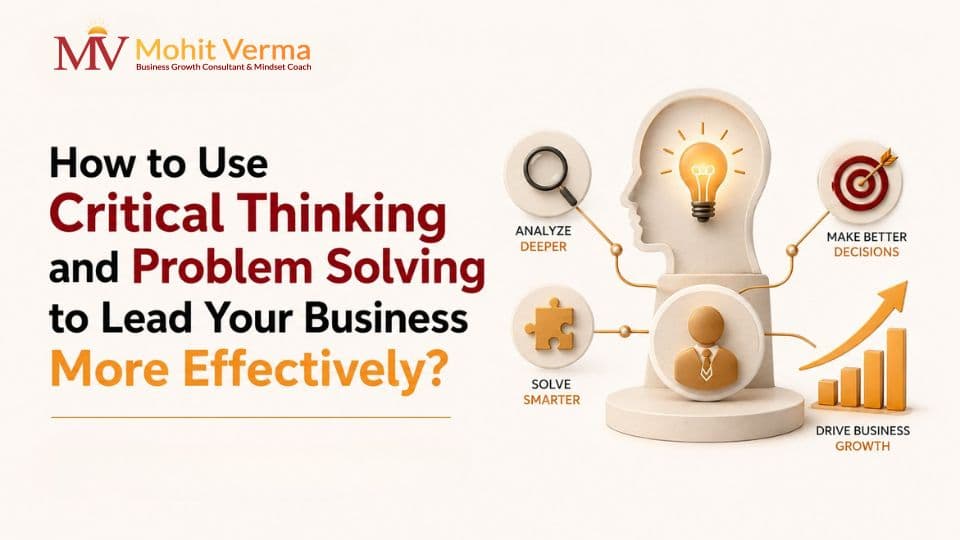
Handling the business in today's volatile market place is equated to tackling the complex maze shape of the market which keeps changing overnight. Every leader is daily faced with ever changing market conditions, disruptive industry changes and tide of information. In order to steer an organization successfully in a volatile environment, one will require more than technical expertise or instinct, knowing how to grow a business with adaptability.
Contemporary leaders need to adopt transfer-able skills that will enable them to cut across structural mysteries effectively. Continue reading to learn the essentials of strategic analysis and how to develop the necessary skill set within the course of your regular leadership duties.
Defining the Core Pillars: Critical Thinking vs. Problem-Solving
It is crucial to understand the meaning of these closely related yet distinctly separate cognitive processes.
Critical thinking is the ability to analyze various sources of information, think about underlying assumptions and make objective judgments based on that. Critical thinking implies the evaluation of diverse sources of information including market research results, consumer data, and other industry-related observations while ignoring the influence of cognitive biases and emotions.
Problem-solving is a particular cognitive activity aimed at identifying barriers in the company, analyzing their roots, coming up with alternative solutions and implementing the best one.
Connection: You may think about critical thinking as a diagnostic tool, while problem-solving as its surgical implementation. Critical thinking diagnoses the situation while problem-solving helps to create and implement actions, which will bring continuous improvement and increase overall performance.
Why These Skills Govern Strategic Decision-Making and Business Outcomes?
When management consciously applies objective analysis in their strategy, the result impacts every aspect of corporate life. Below are five major reasons why development of these skills will lead your business to success:
1. Improved Quality of Strategic Decision-Making
Critical thinking allows the management team to have access to objectively analyzed information. They are then free to rely on facts rather than subjective thoughts. This can be combined with the conceptual and mental tools to avoid behaviors to traditional decision making, such as bias or fallacy, and make any decision more predictable, leveraging tailored business growth strategies.
2. Promotion of Continuous Innovation and Creativity
Strategic thinking on problem solving encourages employees to push operational limits and look for new solutions. When any new solution is challenged and scrutinized by critical thinking, the culture of the organization is built. This culture encourages a company to be innovative, to challenge the paradigms, change the rules and stand out from the others.
3. Proactive Risk Management
In today's commercial environment, there will always be certain structural uncertainties. Effective business thinking allows the decision makers in the company to anticipate the weaknesses of the market and see into the future many adverse situations to formulate effective strategies to control the dangers.
4. Increased Operational Efficiency and Productivity
Without systematic analytical skills people tend to use a lot of valuable resources to treat symptoms of their problem rather than its causes. Developing diagnostic skills leads to better problem solving, provides a barrier against unnecessary work, and demonstrates how to fix founder dependency as systems strengthen.
5. Improved Collaboration and Communication
When everyone in a team follows a consistent mental model based on a line of thinking that is rigorous and step-by-step (stacked in intellectual pyramid structures), it raises personal ego off the table in corporate conversation sets. This provides a like-minded club of respect to various ideas and perspectives for one another, leading to fully cross-functional teamwork.
10 Basic Rules of Critical Business Thinking and Problem Solving
To nurture a corporate culture like these, managers need to make sure that these ten non-negotiable principles are added to their training programs and their daily managerial activities:
Rule 1: Learn Your Ecosystem Information Sources
There is a wealth of information for us to access. Leaders must always be incorporating this information from trustworthy sources. And this requires persistent observation of macro-economic conditions, industry measurements, regulatory changes, digital channels of specialists, and so on.
Rule 2: Be Prepared Aggressively
To "wing it" is to completely fail as a leader. Critical thinking should start with proactive preparation: a deliberate anticipation of cause-effect relationships, data sets, and alternative perspectives long before negotiating, holding a board meeting, or pitching your idea.
Rule 3: Create Proactive, Realistic Priorities Frameworks
The aggressiveness of your preparation has to be put into concrete daily execution. You have to be careful to put in place a scheme of priority that links the daily task with the big direction of your firm. It will make everyone focus on the main drivers of growth instead of getting distracted by trivial activities, an approach guided by a business growth consultant in Gurgaon.
Rule 4: Arrive Early for a Meeting to Observe
Arriving at a meeting exactly when it starts makes you reactive. Arriving 15 minutes before it will give you a chance to observe people in the room, gather informal information, and align yourself mentally. In this way, you'll become the driver of the upcoming interaction.
Rule 5: Practice Radical Presence and Active Listening
Put away your smartphone. If you are not in a frontline job, where you should respond to emergencies in a moment, digital distractions are deadly for deep thinking. Concentrate fully on the experience happening in the moment and make every bit of knowledge gathered your subconscious portfolio for future decision-making.
Rule 6: Communicate Clearly Without Blathering
The best analytical thinkers do not have to oversell anything or use unnecessary corporate jargon. State your strategic conclusions in a clear and transparent manner. It will allow your team to see your vision immediately and give you clean and actionable feedback.
Rule 7: Recognize Your Limitations
Intellectual rigor requires being humble. If you realize that you have blind spots, admit it honestly. Good leaders do not pretend that they know everything. Instead, they are using systematic methods to gather all needed data using proper technical means, often seeking business coaching for entrepreneurs to broaden their scope.
Rule 8: Show Profound Professional Respect
People who are arrogant will isolate themselves from corporate allies. The best analytical minds leverage the power of gratitude and humility to create collaboration networks. They know that a sustainable portfolio of knowledge is based on psychological safety and intelligence of their whole team.
Rule 9: Do Not Skip Any Steps in the Process
If you hurry to get the result, you'll definitely end up with an incomplete solution and poor financial results. Spend enough time on completing every stage of your diagnostic process to achieve your final solution to the problem.
Rule 10: Take Enormous Ownership and Pride in the Work
Feeling profound ownership and pride in your strategy will serve as a psychological engine. It automatically motivates you and your team to invent new paths through operational crises that were completely impossible before, strengthening your overall entrepreneur mindset.
Conclusion
Continuous professional practice and greater open-mindedness is the key to developing such a kind of critical thinking and structure solutioning skills in you and your people. Cultivating this type of thinking skills will enable your company to become a proactive, pioneering leader in the industry.
If you seek an expert opinion, you can schedule a consultation session with Mohit Verma, a dedicated business growth consultant and mindset coach, who will help you get rid of any strategic friction in your organization and apply subconscious healing and high-performance leadership methods.