
How to Reduce Founder Dependency and Build a Self-Sustaining Business?
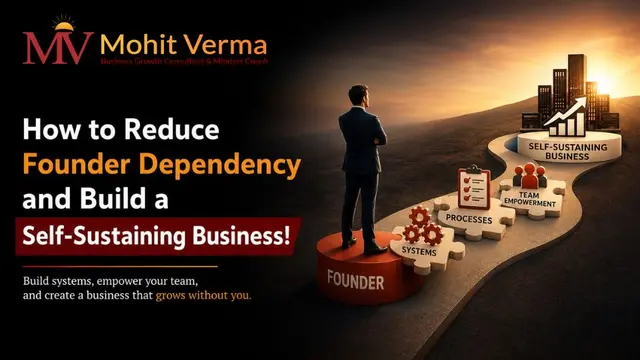
Have you ever wondered what would happen if you stepped away from your business, even for a few days? For many founders, that is an uncomfortable thought because their businesses are highly dependent on their presence for decision-making, relationships, and day-to-day operations. Although this practical method is effective in the initial stages, it ends up being a limitation.
This is where the self-sustaining business comes in, a business that operates on systems, empowered teams, and a structured process instead of always having the founder's input. Learning how to fix founder dependency is essential to unlocking this transition. Read on for a detailed analysis!
Why Is Founder Dependency a Hidden Risk to Business Growth?
Initially, it can be natural to feel in control when one is involved in everything, but as time goes by, it brings restrictions. The business is exposed when all the functions are reliant on an individual. Decisions slow down. Teams are reluctant to do things without authorization, leading to strain in growth and making scaling challenging.
This is a major concern in terms of business scalability. Most businesses that heavily depend on their founders seem risky, whether you want to expand, attract investors, or eventually exit the business. Stakeholders seek stability, systems, and continuity, not dependence.
The idea of reducing founder dependency is not about leaving the company but about creating a system that enables the organization to achieve at a consistent level without your day-to-day engagement, a core principle taught by many business growth consultants in Gurgaon.
Also Check: Fix What’s Holding Your Business Back Before You Invest in Scaling Further!
Best Ways to Reduce Founder Dependency and Build a Self-Sustaining Business
Before diving into the strategies, it’s important to understand this: creating a self-sustaining business is not an overnight shift. It’s a gradual transition from control to clarity. Here are some effective ways to do it:
Systemizing Business Processes for Consistency and Control
The initial move towards curtailing dependency is to establish robust business systems and processes. With well-documented workflows, your business ceases to be dependent upon memory or full-time supervision.
Rather, tasks are performed in a systematic way that anyone within the team can perform. This enhances efficiency of operation, minimizes errors, and guarantees uniformity of results. It also simplifies the onboarding process since new team members can learn the ropes within a relatively short period of time, leveraging strong business growth strategies.
Good Delegation to Develop Ownership and Accountability
Letting go is one of the most widespread challenges founders can have. Delegation is usually hindered by the belief that a person cannot do it better.
But true growth is in empowering others. The concept of strong delegation in business is not only about assigning tasks but passing on ownership and accountability. Your team feels more confident and will be more proactive when they are entrusted with responsibilities.
Building an Effective Leadership Team to Grow Scalably
It takes more than a team to scale a business; it takes leaders. The development of the leadership team will make sure that various spheres of the business are able to operate separately.
When the leaders own their roles, decisions are made more efficiently and in an organized manner. It also creates interdepartmental accountability. This lessens bottlenecks and enables the founder to pull out of day-to-day operations. An effective leadership team is the sure sign of a business that is prepared to grow and develop in the long run.
Sharing Customer Relationships with the Team
Relationships with clients in most founder-led companies are largely centralized around an individual. This establishes a good rapport but also dependency.
To overcome this, it’s important to involve your team in customer interactions. Introducing the account managers gradually and involving communication with the team members will assist in transforming trust in an individual to the organization. Engaging in business coaching for entrepreneurs can help structure this shift smoothly.
Using Technology as a Business Process Automation
Technology is crucial in minimizing dependence on people. The absence of adequate systems makes businesses heavily rely on manual tracking and personal judgment.
The use of CRMs, project management tools, and dashboards helps improve automating business processes and centralizing information. This will enable teams to have access to data in an easy way and make informed decisions.
Installing Succession Planning to Stabilize in the Long-term
Succession planning strategies are strategies that many businesses fail to consider until the time when they are in need of urgency. Nevertheless, it is always best to plan early so that the transition is smoother in the future.
You make a continuity path by identifying and developing future leaders. This instills trust in the organization and among the stakeholders. It also inspires the employees by demonstrating to them growth opportunities. An organization that has an effective succession plan is more adaptable to change and has a higher value over the long term.
Moving to Investor Mindset to Sustainable Growth
The shift of the mindset of an operator to that of an investor is one of the most influential changes that can be made by a founder. You do not work on solving all the problems individually but start developing systems that are problem solvers.
This method focuses on scalability, efficiency, and long-term results. The investor attitude makes you think outside the box, building a true entrepreneur mindset and concentrating on creating a business that will flourish on its own. This change is necessary to make a really self-sustaining company.
Conclusion
Reducing founder dependency isn’t about stepping away completely; it’s about building a business that stays strong without your constant involvement. You can scale your business, make it stable, and really sustainable with the right systems, leaders, and clear processes.
The idea is basic: establish a company that can run without your involvement at every stage. In case you do not know where to begin or require some clarity, consider booking a session with Mohit Verma, a dedicated business growth consultant and mindset coach, for practical guidance and a clear path forward.