
The Hidden Psychological Contract That Decides Every Sale and Pricing Signals!
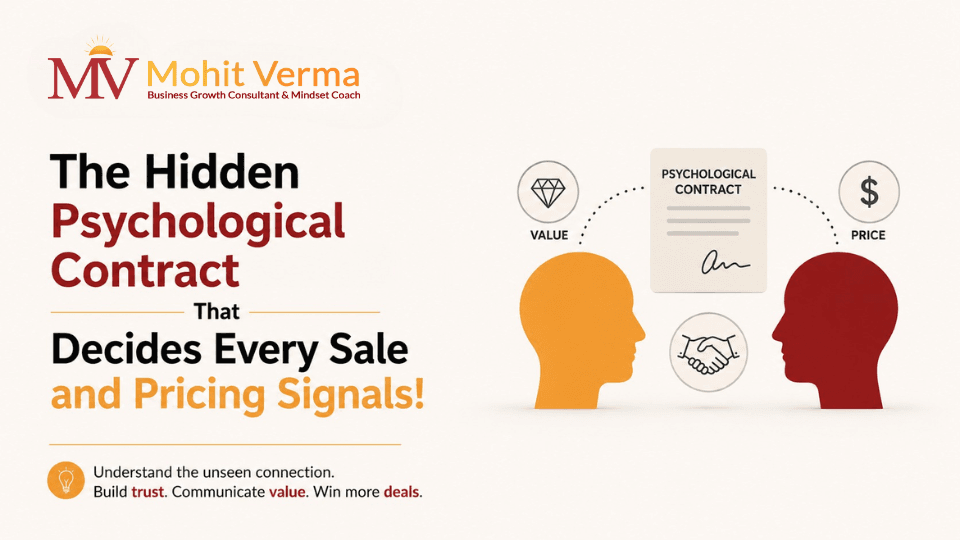
Every time a customer hands over their credit card or clicks "buy now," a silent agreement is signed. Not a piece of paper but something much stronger. This is called a psychological contract. While a formal agreement describes what (product) and how much (price), a psychological contract speaks about the "how" and "why" behind any transaction.
If you learn the secret of this hidden document, you will be able to nail pricing, develop unshakable customer loyalty, and learn how to grow a business fast. Otherwise, you might be confused by the question: Why does my customer go away despite the product was good. This guide will dive deep into the invisible forces that drive consumer behavior and how you can signal the right value to every person who walks through your door. Read on to discover how to master the silent signals that close every deal.
The Idea of Psychological Contract
The concept of the Psychological Contract first appeared in the 1960s, related to the workplace. Back then, it reflected the relationship of workers and employers, the tradeoff between what employees give (their effort, loyalty, etc.) and what employers return to them.
However, nowadays, this term applies to all aspects of life, including the consumer market. In relation to sales, this theory means "fairness or equity" in the eyes of the customer. It is the gap between customer inputs and customer outputs.
The "Iceberg" Of Customer Expectations
Imagine you are having a customer at the store. Your interaction can be compared to the iceberg.
On the Surface (visible): This is the formal contract. It reflects everything that can be seen with the naked eye, like price, product, and its delivery date, etc.
Below the Surface (invisible): This is the psychological contract. It represents 90% of the interaction with customers and contains such components as respect, empathy, "listening" to customers, being valuable, prestige, etc.
When a sale fails, it is rarely because of the 10% above the water. It is usually because the hidden 90% was violated. For example, if a customer feels like a "hostage" to a loyalty program rather than a valued partner, the contract is broken.
The Power of Pricing Signals
What is the real role of prices in the eye of customers? In addition to its practical meaning, price sends an important signal about the "type" of psychological contract one should expect buying the product. There are three main principles of sending such messages.
Read More: How to Fix Profit Leaks and Improve Business Profitability?
1. The High Price Signalizes a Premium Quality Product
If you charge your customers high prices, you signal that they will enjoy a high-level psychological contract. Besides the simple purchase, customers expect an experience and top-class assistance, support and prestige from you.
2. A Lower Price Promotes the Transactional Type of Deal
Lower price means a transactional type of contract where the seller expects less customer engagement in return while the customer expects the highest possible level of efficiency. However, if you offer really cheap prices, it may damage your company's reputation.
3. Fairness: Key Component of the Hidden Contract
The brain is genetically programmed to detect unfair treatment and betrayal. So, if you discover that you pay more than others for the same product with no good reason, your psychological contract with the seller is broken. And the fastest way to rebuild trust is pricing transparency, an approach often recommended by a business growth consultant in Gurgaon.
How to Leverage the Hidden Contract for Business Growth?
If you want to optimize your customer relationships, you need to bring the "hidden" expectations into the light. Here is how you can do so:
1. Visible and Invisible Expectations
In order to optimize business growth, you have to realize that every customer interaction includes two different contracts. There is the formal contract consisting of the product and price, and then, there is the invisible expectations contract.
By bringing all these "hidden" components out in the open, you can resolve issues before they become obstacles. Aligning what customers see with what they feel provides the basis for lasting loyalty which competitors will not be able to undermine.
2. Mapping Strategy Using a Business Growth Consultant
In this process, a business growth consultant is your best ally. They will guide you towards mastering the "visible" components. The analysis of sales funnels, pricing structures, and other such details provides the technical backbone needed for effective signaling.
Without it, even the most empathetic approach will ultimately fail, as the business processes will not be able to meet clients' expectations, which is essential when looking for the best business consultant in India.
3. Building the Human Connection via a Mindset Coach
As this type of contract is based upon human emotion, the assistance of a mindset coach in Gurgaon is absolutely necessary. By using the expertise of such specialists, you can develop the necessary level of empathy and compassion required to view your clients as unique individuals. As a result, you can optimize your inner processes.
4. Balancing the "What" and the "Why"
Growth occurs when you combine the technical "what" of the visible component with the emotional "why" of the psychological component. Although the technical aspect is what brings new customers through the door, it is their satisfaction which keeps them there.
The ability to master the connection between the "what" and the "why" ensures that your signaling is always aligned with your high-level experience.
5. Moving Away from the Transactional Model
The final step in using the hidden contract consists in switching from merely transactional models towards relational. In this approach, reliability becomes key alongside the appreciation of customers' loyalty. This transformation lowers the acquisition costs and creates a virtuous circle in which satisfied clients refer you to potential buyers.
Below is a table outlining the difference between the visible and psychological components of the sale:
Visible Contract (The "What") | Psychological Contract (The "Why") |
Product Features | Peace of Mind |
Price Point | Feeling of Importance |
Delivery Speed | Trust and Reliability |
Discount Codes | Recognition of Loyalty |
The "Hidden Psychological Contract" is the foundation of every successful transaction. You cannot win on price alone, and you cannot win on "vibes" alone. You need a balance of clear pricing signals and a deep, unspoken commitment to the customer's well-being.
Conclusion
As demonstrated above, the "hidden psychological contract" lies at the core of each transaction. It cannot be built either through pricing alone or through vibes alone. Instead, a perfect blend is required. In order to fully benefit from the power of this concept, one has to stop viewing their own business from the viewpoint of mere transactions and focus on keeping promises. Once you align the "invisible" aspects of the process with the visible ones, your business will flourish.
If you are ready to master these dynamics and take your professional journey to the next level, it is time to work with an expert who understands both the mechanics of profit and the nuances of the human mind. Mohit Verma is an expert business growth consultant dedicated to helping leaders bridge the gap between strategy and psychology. Book a session today!