
Growth Mindset vs Fixed Mindset: What Every Professional Should Know!
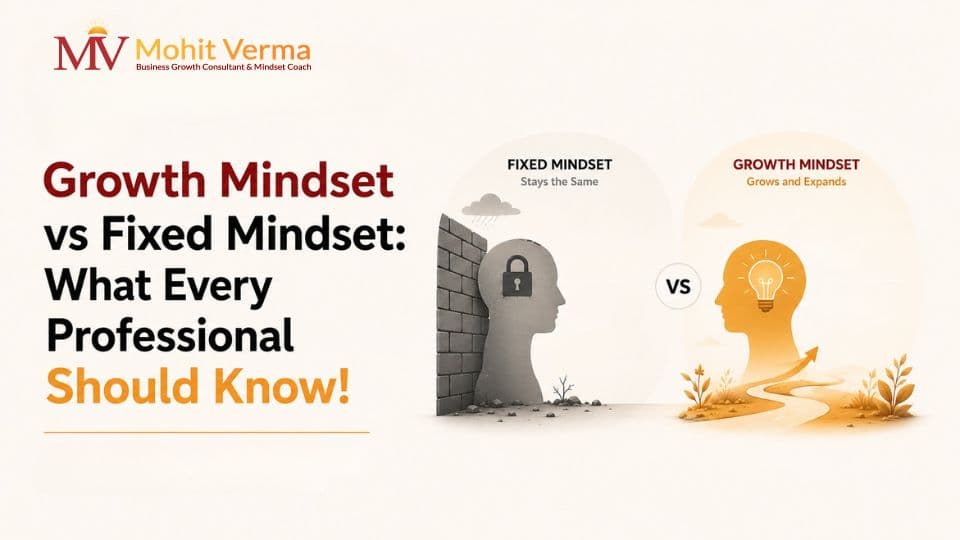
It is a well-known phenomenon in the corporate world: when you observe the achievements of a successful colleague or an industry leader, the first thing that usually comes to mind is, "Wow, they were born to be like that". Yet, what if that was not so? What if the set of skills and abilities that makes one stand out from a crowd in their profession was not inherent talent but a certain way of thinking about their mental potential? This concept is commonly known as the difference between growth mindset and fixed mindset.
Choosing between those two will determine not only your attitude to the feedback but also your reaction to industry disruption, which is crucial in determining your future success and learning how to grow a business. Read on to discover how mastering your mindset can transform your daily work, unlock your true potential, and skyrocket your professional growth.
What is a Fixed Mindset?
The core idea of the fixed mindset theory is that intelligence, talents, and skills are inherent properties of a person, which cannot change over the course of a lifetime.
In the corporate setting, a professional with a fixed mindset feels like they should always look smart to be able to perform any job. For them, every challenging situation is a catastrophe. According to the fixed mindset logic, either you know everything and you can complete any assignment flawlessly without making a mistake or you don't have enough skills – period.
What is a Growth Mindset?
On the contrary, a growth mindset is based on the belief that human capabilities and skills are flexible and may be developed over time through practice, application of proper strategies, and learning.
It does not mean that anyone becomes an expert overnight with a sudden boost of knowledge. It means that progress is achieved through the acquisition of new skills and abilities. A growth mindset professional considers not knowing anything about an issue a temporary condition. Failures are viewed not as disasters but as part of the process that provides valuable information to bounce back and achieve better results next time, which is fundamental to how to cultivate a winning mindset.
The Key Differences Between Growth Mindset and Fixed Mindset in a Corporate Setting
If you want to understand how those two mindsets operate in the business sphere, take a look at professionals' reactions to various events and tasks at work.
Handling New Skills
Let's say you have an interest in management and you are trying to learn basic financial skills to create budgets. If your mindset is fixed, you would tell yourself something like, "I am bad with numbers, so it is impossible for me to learn accounting". If you think that way, you have chosen the fixed mindset approach.
On the other hand, a professional who has a growth mindset would approach that same budget spreadsheet with such thoughts, "My finance background is quite limited, but that does not mean that I can't learn and improve my skills with time".
Receiving Feedback
In today's corporate reality, it is a constant challenge to accept any kind of constructive criticism without feeling insulted. However, a person with a fixed mindset will consider every bit of feedback a personal criticism or confirmation of their limitations. In some cases, people hide their weaknesses for fear of being judged by others.
In contrast, a growth mindset professional treats feedback simply as a form of information that needs to be analyzed to identify any weaknesses in order to correct their strategies.
Dealing With Challenges
Whenever you face a problem or encounter a failed project/client, your reaction may reveal your mindset type. People with a fixed mindset are easily intimidated and tend to quickly give up because they feel like this situation is threatening to their ego. Individuals with a growth mindset perceive all obstacles as opportunities to improve themselves.
Mindset Shift Science and Neuroscience Explained
According to scientists, the brain ceases to evolve after we turn adults. However, modern neuroplasticity studies have proved that human brains are constantly forming new connections, changing, and adapting to any experience through life. Neuroimaging research allowed discovering the distinct characteristics of a person's brain activities depending on their mindset type.
Specifically, people with a growth mindset have increased brain activity in these two regions:
Anterior Cingulate Cortex (ACC): It is responsible for active learning and behavioral control.
Dorsolateral Prefrontal Cortex (DLPFC): It allows monitoring errors and adjusting our behavior accordingly.
While reviewing mistakes in a test or a project, a fixed mindset individuals' brain does not seem to react; it simply tunes out the mistake. In the case of growth mindset professionals, brain activity significantly rises, as it focuses on analyzing the mistakes to learn from them rather than just completing assignments.
Apart from this, a growth mindset also has a great effect on how our bodies cope with stress. It lowers the risks of professional burnout and stress-related illnesses by restructuring neural circuits associated with threat response, helping refine how to improve your money mindset and stress resilience.
The Need for a Growth Mindset in Any Career
This approach goes beyond being merely a neat psychological concept – it is crucial to achieving professional success in today's rapidly changing world. Here are some reasons why professionals should adopt a growth mindset approach:
It Helps You Shift to Other Industries
In times of artificial intelligence and rapid changes in the markets, the previous profession does not determine your future career options. With a growth mindset, you are able to successfully enter completely different industries. The fact is that you know you can easily understand any industry language thanks to professional practice and training.
It Builds Your Resilience
Professional resilience is the ability to survive tough corporate situations. Since business environments are quite unpredictable, your professionalism largely depends on your perseverance. By considering every mistake you made as useful feedback, you keep being inspired to come up with new solutions.
It Makes Iterative Development of Your Business Possible
The concept of business development is iterative and includes constant search for opportunities, resources, and customer satisfaction. Otherwise, if you are afraid of getting some negative feedback, you risk developing an untested product of low-quality with no customers. When having a growth mindset, you will be able to develop products that meet customers' needs using adaptable business growth strategies.
It Helps Remain Humble and Evolve Professionally
When using a growth mindset, one constantly thinks that there is still a lot to be learned. Such a state of mind keeps a person from getting lazy when acquiring new knowledge. Since customer needs and industry trends may differ with time, staying humble means continuously growing and evolving as a professional.
Key Strategies for Adopting a Growth Mindset Mentality
Developing a growth mindset requires certain efforts as well as a lot of patience. Here are five strategies one can use in order to adopt such a mentality and be successful in one's career:
Getting Rid of the Fixed Mindset Inner Voice
When having a growth mindset, pay close attention to your internal voice. For example, if your thoughts are something like "I cannot be trusted with this task, because I am not intelligent enough", consciously stop yourself and think, "Maybe I do not know how to perform this task yet, but I can learn if I put some effort".
Also Check: The Ultimate Guide to Developing a Winning Mindset for Life and Business!
Celebrating and Rewarding Processes, Not Just the Results
When focusing on final achievements, one often ignores other processes that were used to achieve them. As a rule, it is the persistence, hard work, and smart strategies that guarantee success in any project.
Actively Seeking for Feedback
It may be hard for people to accept negative feedback at the first attempt. However, instead of perceiving it as a personal attack, try to analyze every word and find some advice for yourself there. Getting constructive criticism and feedback from your colleagues can help you improve your work processes.
Stepping Out of One's Comfort Zone
Growth never occurs when being in a comfort zone. First, you should start trying small things that require some effort on your part. Then, you need to become confident and willing to take on challenging and complex tasks, a core pillar of business coaching for entrepreneurs.
Surrounding Oneself with Like-minded People
It is important to develop an environment around yourself that supports and motivates everyone to learn and overcome their fears. Positive behaviors and actions of such people can act as excellent role models for you.
Conclusion
In conclusion, it is important to admit that talents and intellectuality are not constant attributes. Being aware of all the differences between a growth mindset and a fixed mindset, one opens up a huge possibility of making mistakes, getting some feedback and moving further.
Professional success lies in the willingness to improve oneself constantly. Book a session with Mohit Verma, a dedicated business growth consultant and mindset coach, to elevate your professional potential today!